Justin Gaethje: From Safford Wrestler to UFC Champion and the Evolution of “The Highlight”
Justin Gaethje: From Safford Wrestler to UFC Champion and the Evolution of The Highlight
Justin Gaethje has built one of the most recognizable careers in modern MMA, transforming from a Division I wrestler from Safford, Arizona, into a UFC lightweight champion known for devastating knockouts, relentless pressure and unforgettable wars inside the Octagon. Nicknamed “The Highlight,” Gaethje has faced some of the toughest names in UFC history and endured some of the most dramatic highs and lows the sport can offer.
What makes the Justin Gaethje story compelling is not simply his power or willingness to fight through adversity. His career is a story of evolution. After establishing himself as an undefeated champion outside the UFC, Gaethje entered the promotion with a reckless, all-action style that produced spectacular victories but also exposed him to punishing defeats. Working with renowned coach Trevor Wittman, he gradually transformed that chaos into a more calculated and technically refined approach.
From his wrestling roots and WSOF championship run to his battles with Eddie Alvarez, Dustin Poirier, Khabib Nurmagomedov, Charles Oliveira, Tony Ferguson and Max Holloway, Justin Gaethje’s UFC career has been defined by risk, resilience and reinvention. His eventual rise to the undisputed UFC lightweight championship added the biggest achievement yet to a career built on refusing to take the easy path.
Here is the story of how Justin Gaethje became one of MMA’s most compelling fighters—and how “The Highlight” learned to turn controlled chaos into championship success.
Justin Gaethje’s Safford Roots Built His Competitive Identity
Gaethje’s story begins in Safford, Arizona, a small community with deep ties to the copper-mining industry.
His mother worked for the post office, while his father spent decades working in the mines. Gaethje and his fraternal twin brother were introduced to wrestling at a very young age, and competition quickly became a central part of their lives.
Gaethje has spoken about starting wrestling when he was four years old. His parents made significant sacrifices to help him and his brother travel to tournaments and pursue opportunities beyond their hometown.
That environment shaped more than Gaethje’s physical abilities.
It also helped create his unusual relationship with losing.
Because his family’s support was not dependent on whether he won or lost, Gaethje developed a willingness to compete without constantly worrying about the consequences of failure.
That mentality would eventually become one of the defining characteristics of his MMA career.
He could take risks because losing did not change who he was outside the cage.
From Division I Wrestling to MMA
Gaethje eventually continued his wrestling career at the University of Northern Colorado, where he became a Division I All-American and finished seventh at the NCAA Championships.
Wrestling gave him a powerful foundation, but his future in MMA was still far from certain.
One of the most important moments in his transition came when several elite MMA fighters visited his college to train.
Among them was Georges St-Pierre.
For Gaethje, training with a fighter of St-Pierre’s stature helped change his perception of professional MMA. The sport’s biggest stars were no longer distant figures on television. They were athletes he could meet, train with and compete against.
The realization helped convince him that MMA could become more than an experiment.
His amateur career began in 2008, and Gaethje quickly discovered that the combination of wrestling and raw athleticism could be extremely dangerous.
He eventually went 7-0 as an amateur before turning professional.
The next phase of his career would introduce the MMA world to one of its most aggressive lightweight fighters.
The WSOF Years Created The Highlight
Before entering the UFC, Gaethje built an undefeated professional record and became the World Series of Fighting lightweight champion.
He defended the championship five times, establishing himself as one of the most dangerous lightweight fighters outside the UFC.
His fights against Luis Palomino became especially memorable.
The two men repeatedly exchanged enormous strikes, turning their bouts into violent, exhausting battles that showcased everything Gaethje represented at the time.
His philosophy was straightforward: create collisions, generate pressure and make the opponent uncomfortable.
Gaethje wasn’t simply trying to win exchanges.
He wanted to turn every exchange into an event.
That approach made him a fan favorite, but it also came with an obvious cost.
Every unnecessary exchange meant more damage.
Every hard kick meant more punishment to his legs.
Every wild firefight increased the possibility that one perfectly placed shot could end the night.
Gaethje’s style was spectacular, but questions about its long-term sustainability were impossible to ignore.
Justin Gaethje’s UFC Debut Was an Instant Classic
When Gaethje finally arrived in the UFC in 2017, he entered the promotion with a perfect 17-0 professional record.
His first opponent was Michael Johnson.
The fight immediately became a showcase of Gaethje’s extraordinary durability and aggression.
Johnson hurt Gaethje badly, but Gaethje continued moving forward. Eventually, he turned the momentum around and stopped Johnson in the second round.
The fight earned widespread praise and reinforced the idea that Gaethje’s spectacular style could work against elite UFC competition.
But there was another side to the story.
Gaethje was winning fights while absorbing an enormous amount of damage.
And eventually, the damage caught up with him.
The Losses That Forced Justin Gaethje to Change
Gaethje suffered consecutive knockout defeats against Eddie Alvarez and Dustin Poirier.
For the first time in his professional career, he had to confront the possibility that simply being tougher than his opponent wasn’t enough.
The losses became a turning point.
Instead of doubling down on the same approach, Gaethje began working more closely with Trevor Wittman.
The goal wasn’t to remove the aggression that made Gaethje special.
It was to control it.
That distinction became one of the most important developments of his career.
Gaethje didn’t need to become a completely different fighter.
He needed to become a smarter version of himself.
Trevor Wittman Helped Turn Chaos Into Control
Under Wittman’s guidance, Gaethje began making significant adjustments.
His defensive movement improved. His shot selection became more disciplined. He became more willing to use his wrestling strategically rather than relying almost exclusively on striking exchanges.
Most importantly, he learned how to choose when to engage.
The wild fighter was still there.
But now there was a system behind the violence.
Gaethje’s next run demonstrated the impact of those changes.
He stopped James Vick, Edson Barboza and Donald Cerrone before receiving a massive opportunity against Tony Ferguson.
And against Ferguson, Gaethje produced one of the most disciplined performances of his career.
Justin Gaethje vs. Tony Ferguson Changed His Career
Gaethje accepted the fight with Tony Ferguson on short notice, with the interim UFC lightweight championship on the line.
Ferguson entered the contest riding an extraordinary winning streak and carrying enormous momentum.
Gaethje refused to be drawn into a reckless firefight.
Instead, he remained patient.
He attacked Ferguson’s legs, controlled distance and punished him with accurate combinations while avoiding many of the unnecessary exchanges that had defined his earlier UFC appearances.
Eventually, Ferguson’s corner stopped the fight.
Gaethje had won the interim lightweight championship.
The victory was significant for more than the title itself.
It proved that “The Highlight” could still produce violence without allowing the fight to completely control him.
The chaos was still there.
Now it was controlled chaos.
Khabib Nurmagomedov and Charles Oliveira Presented Different Challenges
Winning the interim title gave Gaethje another opportunity to become undisputed champion.
His first undisputed title challenge came against Khabib Nurmagomedov.
Khabib’s pressure, wrestling and top control created a completely different problem from the opponents Gaethje had previously faced.
Gaethje was eventually submitted in the second round.
Two years later, he received another opportunity against Charles Oliveira for the vacant lightweight championship.
Oliveira submitted Gaethje in the first round, once again leaving him just short of undisputed UFC gold.
For many fighters, consecutive championship disappointments might have marked the end of the road.
For Gaethje, they became another chapter in a career defined by persistence.
The BMF Era Added Another Chapter to Gaethje’s Legacy
Gaethje continued competing at the highest level and produced another memorable rivalry with Dustin Poirier.
Their rematch at UFC 291 was one of the biggest moments of Gaethje’s career.
This time, the result was different.
Gaethje stopped Poirier with a head kick in the second round to capture the symbolic BMF championship.
The victory also demonstrated how much his game had evolved.
The same fighter who had once been willing to absorb almost unlimited punishment was now capable of finding a precise opening and ending a major fight with one perfectly timed technique.
UFC 300 Delivered Another Brutal Setback
Gaethje entered UFC 300 against Max Holloway with the BMF title on the line.
For almost five rounds, the fight delivered the kind of high-level violence fans had come to expect from Gaethje.
Then came the final second.
Holloway knocked Gaethje out with a dramatic last-second punch, ending the fight at 4:59 of the fifth round.
It was one of the most devastating defeats of Gaethje’s career.
But once again, the setback did not end his pursuit of another championship opportunity.
Instead, Gaethje continued moving forward.

Justin Gaethje Finally Captured the Undisputed UFC Title
In January 2026, Gaethje defeated Paddy Pimblett by unanimous decision to win the interim UFC lightweight championship.
That victory put him on a collision course with undisputed champion Ilia Topuria.
The stakes were enormous.
Topuria entered the matchup undefeated and already established as one of the UFC’s most accomplished young champions. Gaethje, meanwhile, was chasing the one major achievement that had repeatedly escaped him.
Then came UFC Freedom 250.
On June 14, 2026, Gaethje faced Topuria on the South Lawn of the White House in Washington, D.C.
The fight became the defining moment of his career.
Topuria had his moments and hurt Gaethje during the contest, but Gaethje gradually turned the momentum around. His pressure, striking and veteran composure began to take over as the fight progressed.
After four rounds, Topuria’s corner stopped the contest.
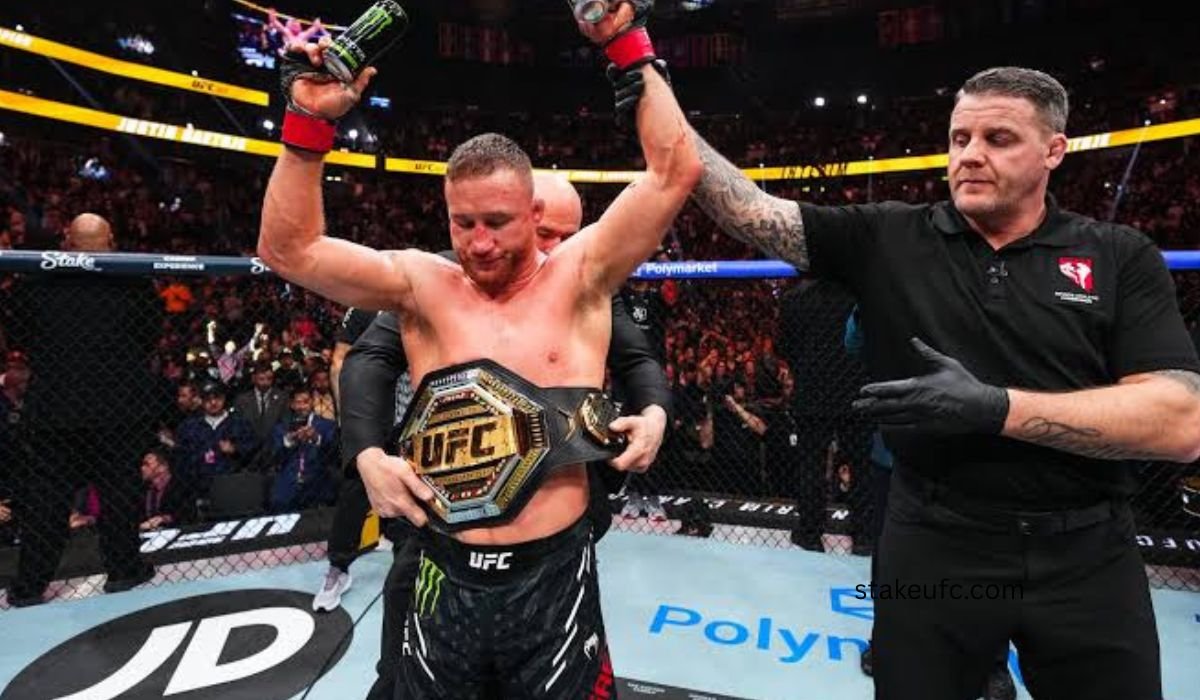
Gaethje was the undisputed UFC lightweight champion.
The victory completed a journey that had begun decades earlier in a small Arizona town.
From Chaos to Championship Discipline
What makes Gaethje’s career remarkable is not simply the number of memorable fights.
It is the evolution behind them.
The early version of Gaethje believed in pressure, punishment and creating spectacular collisions.
The later version learned how to manage distance, choose exchanges and conserve his resources without losing the aggression that made him dangerous.
That evolution allowed him to remain competitive at the highest level long after his original style might have suggested a shorter career.
He never completely abandoned chaos.
He learned how to control it.

Justin Gaethje’s Legacy Goes Beyond the Titles
Gaethje’s career now includes a World Series of Fighting championship, multiple UFC title opportunities, an interim UFC lightweight championship, the BMF title and an undisputed UFC lightweight championship.
But the numbers only tell part of the story.
His career has been defined by the willingness to accept difficult challenges, recover from devastating defeats and repeatedly rebuild his approach.
From a wrestling room in Safford to the biggest stage in MMA, Gaethje has consistently carried the lessons of his upbringing with him.
His parents taught him that competition was worth pursuing.
Wrestling taught him discipline.
MMA taught him that toughness alone was not enough.
Trevor Wittman taught him how to turn aggression into strategy.
And his defeats taught him how to evolve.
That may ultimately be the most important part of Justin Gaethje’s story.
The Highlight never stopped being the fighter who loved chaos. He simply learned how to make the chaos work for him.